01 / 06
Real terminals, on a canvas
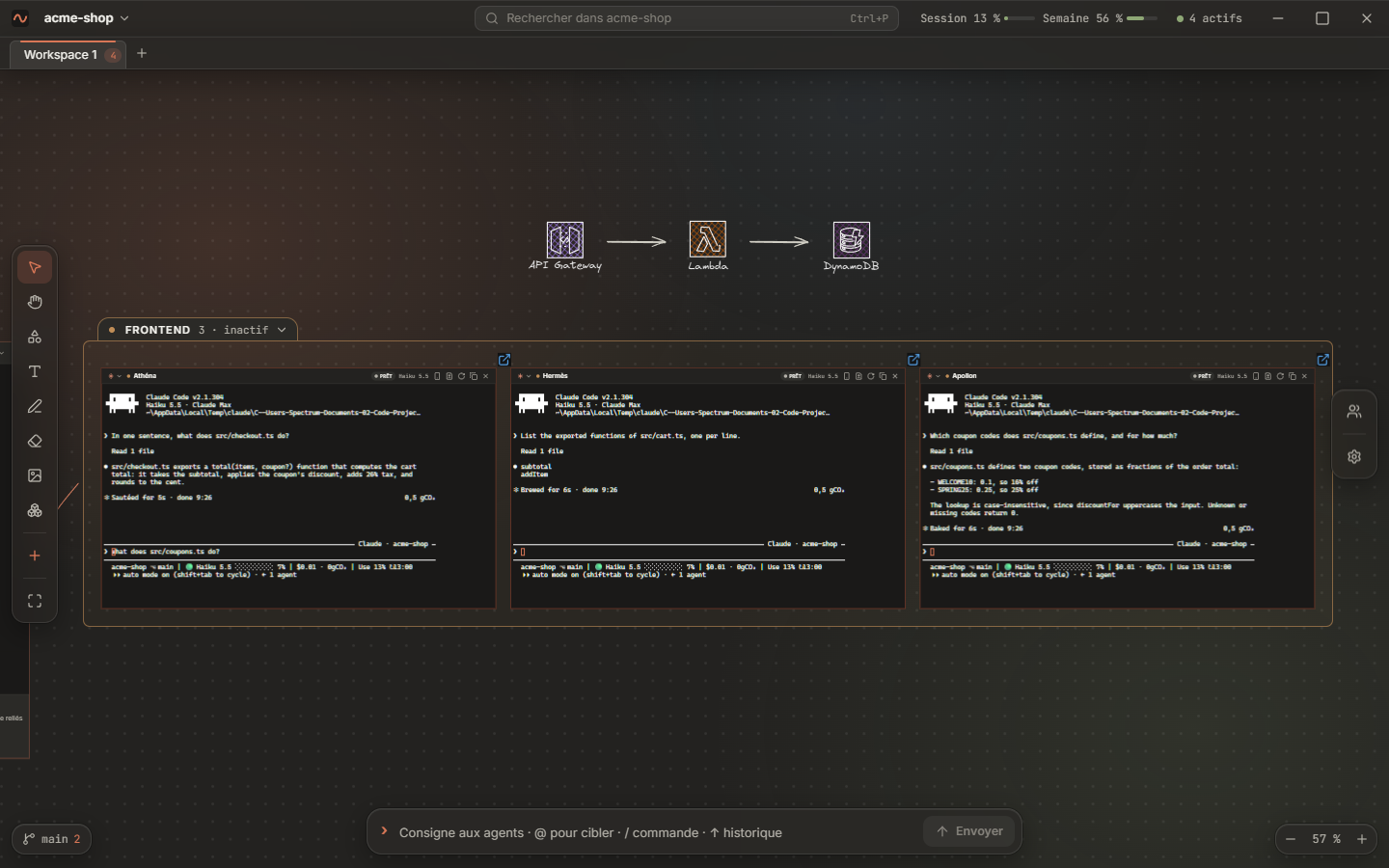
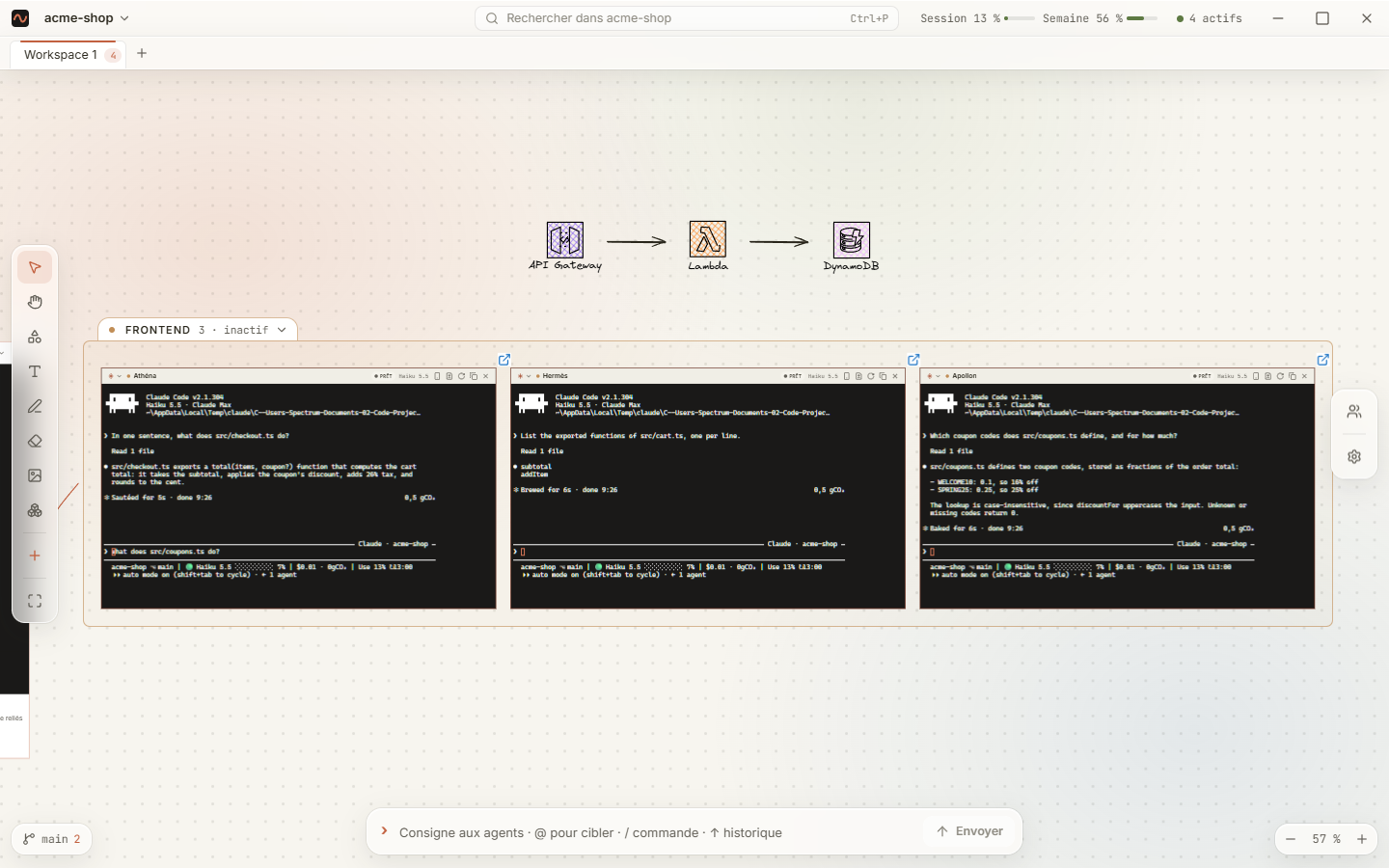
Every agent is a real terminal, rendered by xterm.js. Pan, zoom, draw around your agents and annotate their work: the canvas is Excalidraw, shapes, arrows and text included.
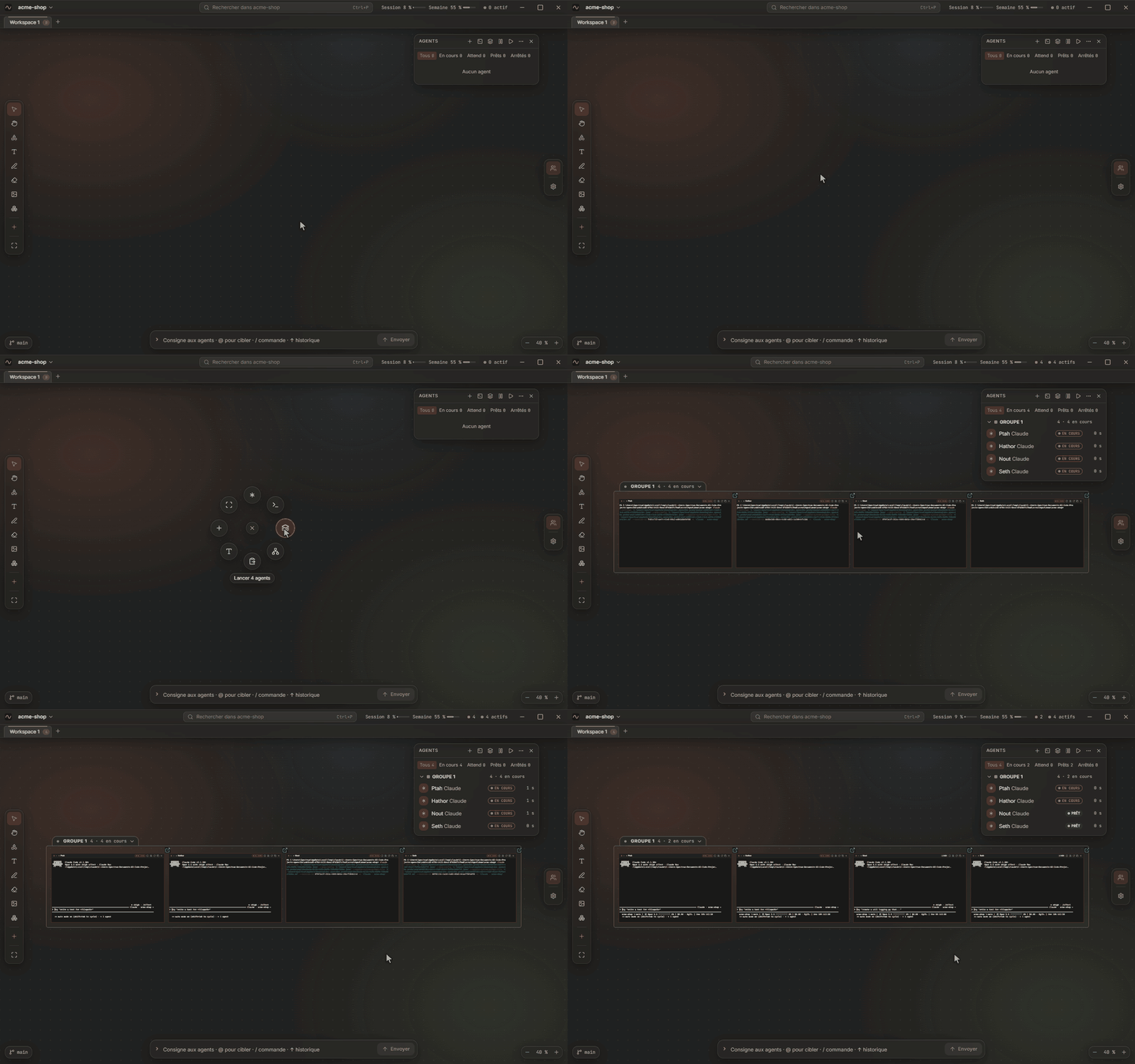
Every agent runs in a real terminal. Group them into teams, brief them in one line, review their changes and hand the big jobs to an orchestrator.
Free forever · MIT licence · Everything stays on your machine
Six chapters, one demo each. Every demo comes from the app, recorded on real sessions.
Every agent is a real terminal, rendered by xterm.js. Pan, zoom, draw around your agents and annotate their work: the canvas is Excalidraw, shapes, arrows and text included.
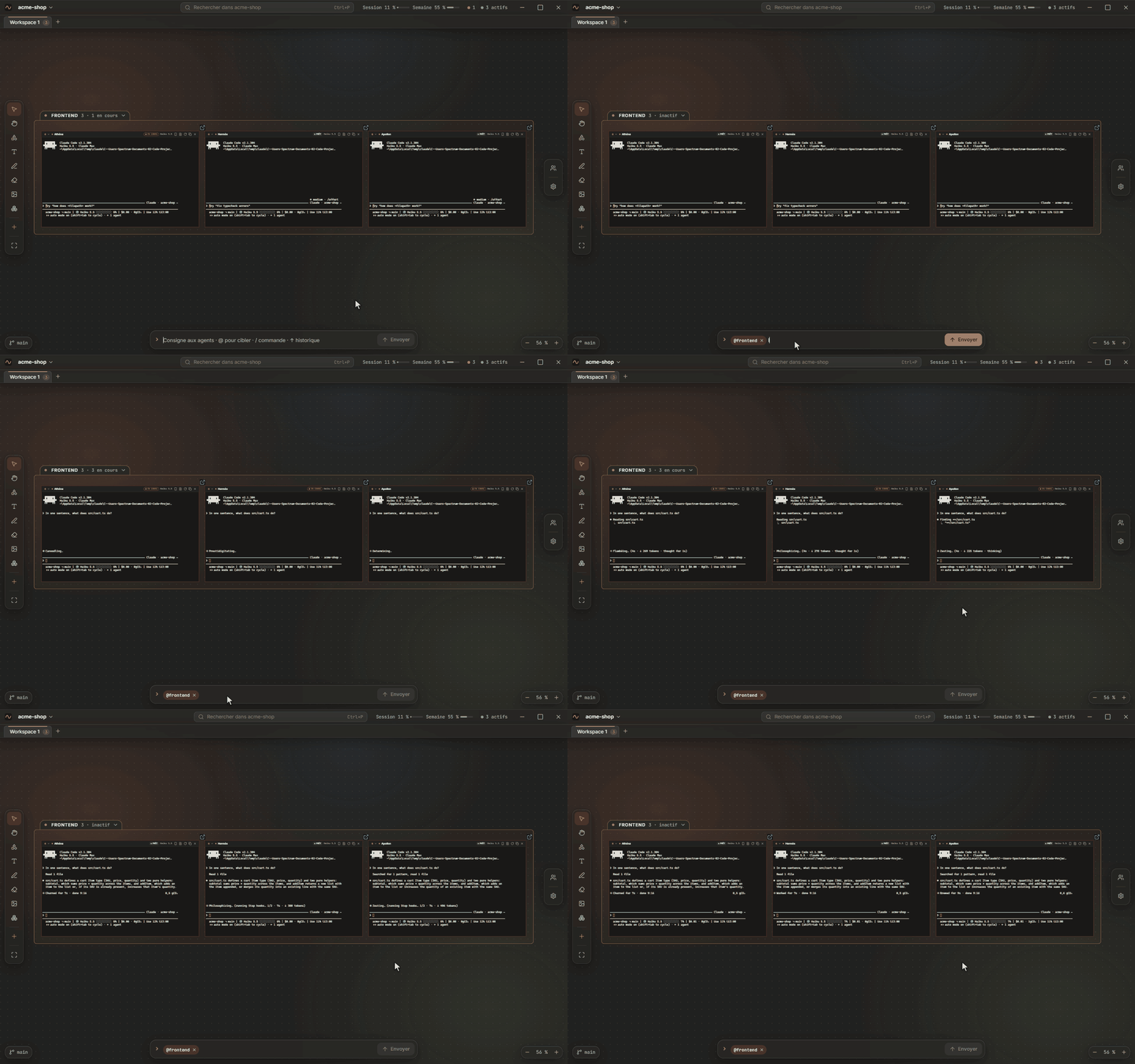
Build a group with a role (Frontend, Backend, Testers…) or launch four agents at once. Type @frontend and the instruction goes to the whole group; a line that starts with / goes to every agent as a command.
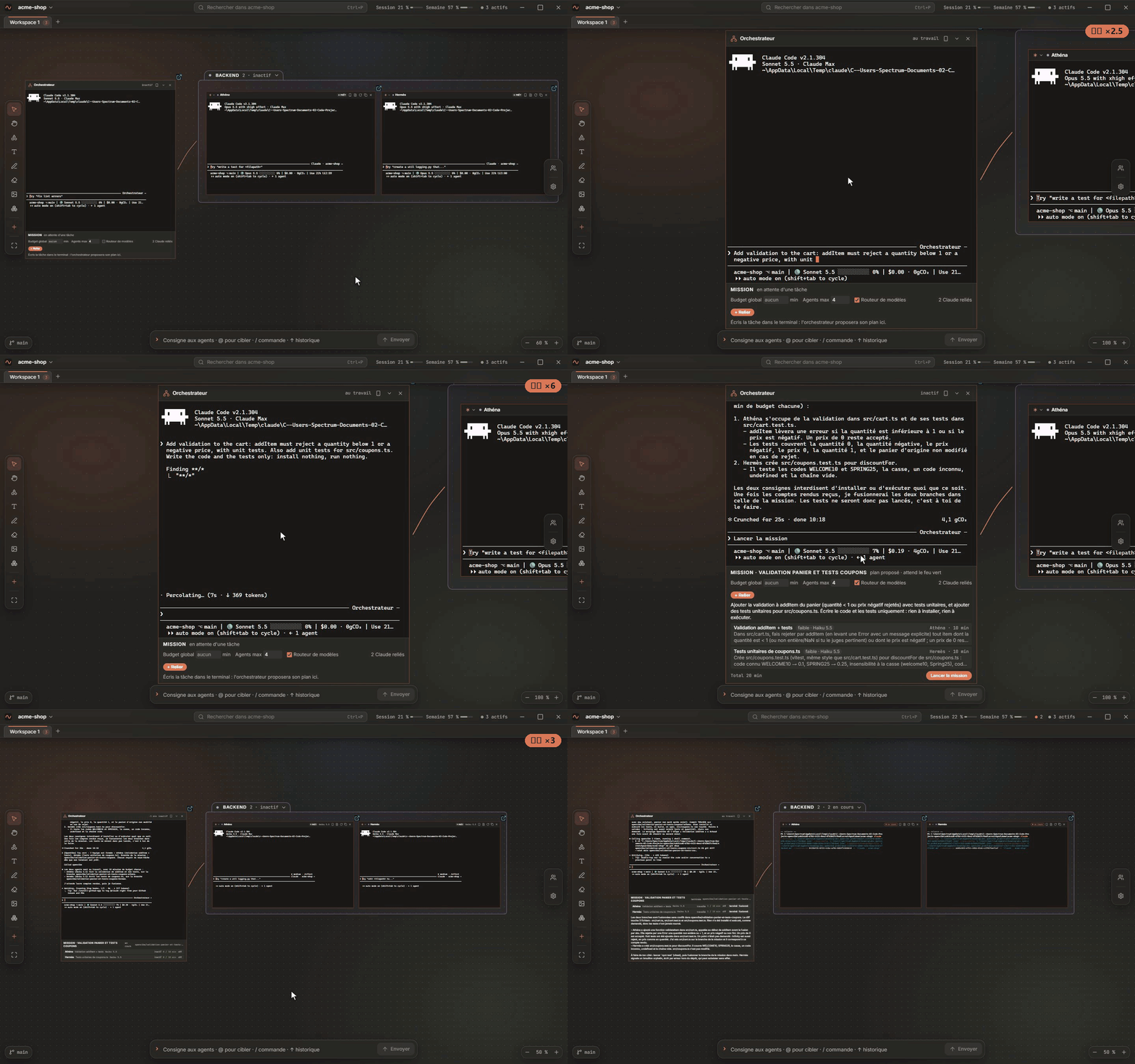
Give it a goal. It proposes a plan, hands each agent a subtask on its own branch and worktree, watches the time budget and merges the results into a mission branch. It never pushes.
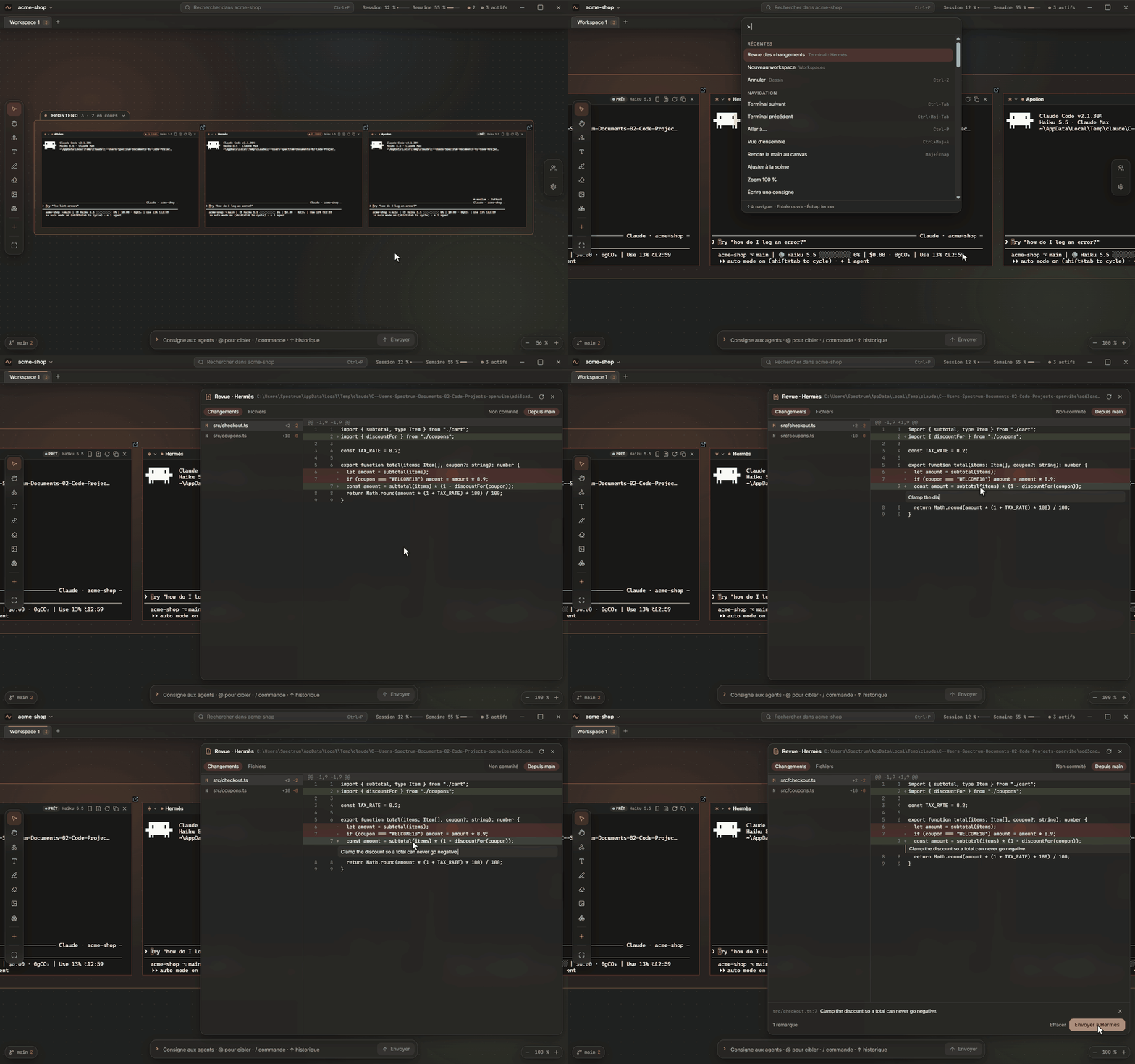
See what an agent changed, uncommitted or since its base, and browse the repository read-only. Click a line to leave a comment: they all go back to the agent in one message.
Say how long you'll be away. An orchestrator plans, the team works through a queue of tickets, and a morning report waits for you: what's done, what failed, what to check by hand.
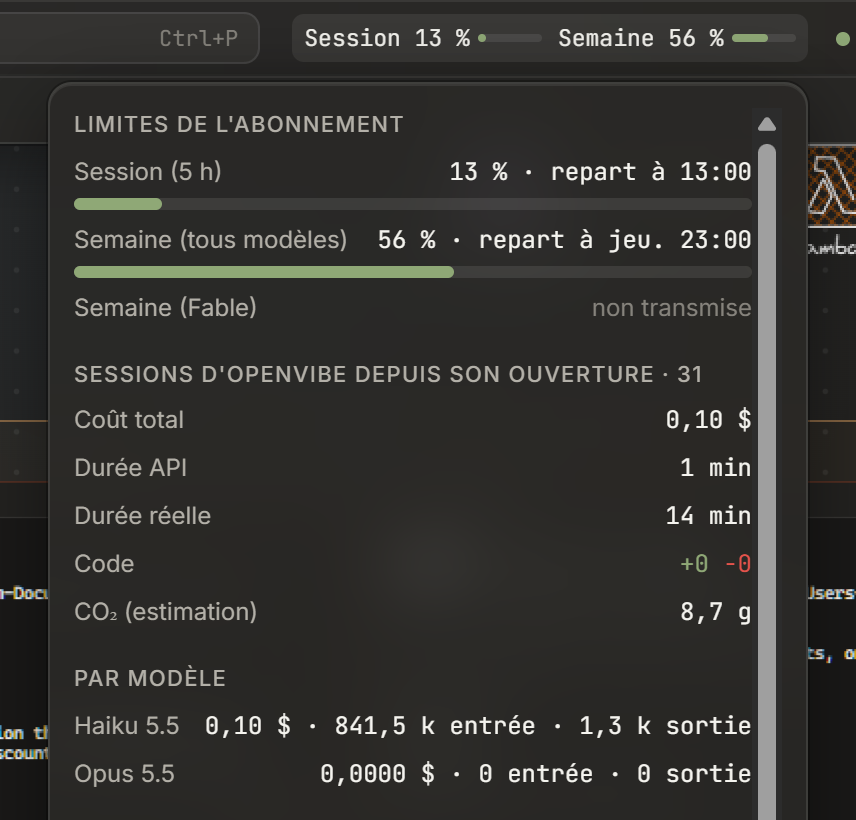
Your Claude plan’s session and weekly limits, cost, durations, tokens per model and prompt cache state. OpenVibe reads the logs already on your disk: nothing is sent.
An agent is available as soon as its command is on your PATH.
Fix a file by hand: repository tree, tabs, Ctrl+S and Markdown preview.
Markdown files linked with [[name]], with a graph and backlinks, readable by agents.
Resend an instruction on a schedule, with a maximum number of rounds or a time limit.
Diff, per-file commits, history, and a Push button that names its target.
Follow one agent, a group or the whole team from your phone.
One profile per folder. OpenVibe never reads, copies or keeps a credential.
About 600 AWS, Azure, GCP and system design icons, built in.
The official command, shown in full, run in a visible terminal.
To you, who work with agents,
A coding agent is a terminal. Two agents, two windows. Beyond that, you lose track of who is waiting for an answer, who is done, and what changed in the repository.
The tools we had were not built for this. A multiplexer arranges terminals; it doesn't know an agent is waiting for your go-ahead.
OpenVibe starts from a simple idea: put each agent on a canvas, the way you put ideas on a whiteboard. You watch them work, group them into teams, talk to them in one line, and review what they did.
Everything runs on your machine, with no account and no telemetry. The code is open, under the MIT licence, and the engine will stay free.
This is for you.
Teams that need control over budgets, access and deployment will move to Enterprise.
Free includes the whole open-source engine, with no time limit · Enterprise features are in preparation
Yes. The complete engine is open source, under the MIT licence, and free for everyone. The Enterprise plan, in preparation, is for teams that need control over budgets, access and deployment.
No. OpenVibe adds no online service and no telemetry. Its only request is the update check, which you can turn off in the settings. This website doesn't track you either: no cookies, no analytics.
Claude Code, Codex, Gemini CLI, Qwen Code, Cursor, OpenCode, Aider, Ollama, the Windows shells and any command you choose. Missions, Remote Control and the usage meter rely on Claude Code.
OpenVibe is a preview, built and tested on Windows 10/11. It is the only supported platform for now.
The betas are not signed yet. In SmartScreen, choose "More info", then "Run anyway".
No. OpenVibe covers the same ground, piloting a fleet of agents from a canvas, as an independent open-source project with its own design and features.
I'm Mathieu Kerbel, a cloud architect, FinOps engineer and author. OpenVibe is my open-source project. On mathieukerbel.com I make one case: build more, spend less.
Visit mathieukerbel.com